
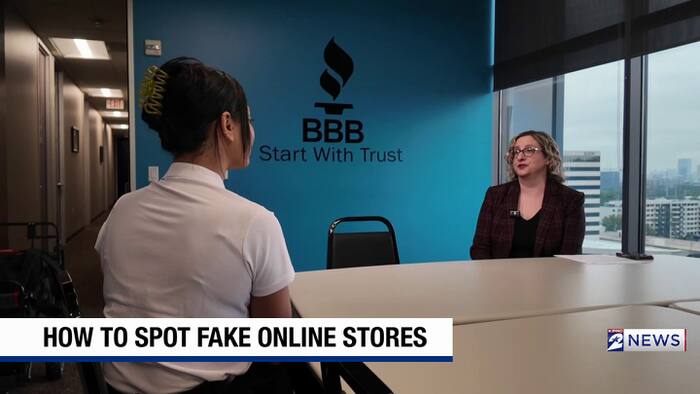
As Black Friday approaches and holiday shopping shifts online, scammers are using artificial intelligence to build fake stores that look almost identical to legitimate retailers — and Houston-area shoppers are already losing money.
Online purchase scams are nothing new, but artificial intelligence is raising the stakes. Scammers can now generate polished, professional-looking websites — complete with product photos, detailed pages and functional checkouts — in minutes.
KPRC 2 demonstrated just how easy it is, building a convincing fake storefront using AI in less than five minutes.
“You can’t just go by how the website seems or looks nowadays,” said Leah Napoliello, vice president of investigations and public affairs at the Better Business Bureau of Greater Houston.
That’s a dramatic shift from just a few years ago, when red flags like misspellings or low-quality images made fake sites easier to spot. AI has largely erased those tells.
“The AI can erase a lot of those errors,” Napoliello said. “They can make it look very professional, so you can’t just go by how the website seems or looks nowadays.”
The BBB’s Scam Tracker database shows just how widespread the problem has become — and how convincing these fake stores can be.
One Houston-area shopper reported losing $43.90 after spotting what appeared to be a “going out of business” sale on Instagram offering free bags — just pay shipping. The shipping cost turned out to be exorbitant, and the shopper quickly realized something was wrong. By then, the bank debit had already processed and could not be stopped. The site was flagged as an imposter of a business called Jennifer Bags.
Another shopper lost $49.99 attempting to buy a scooter from a site impersonating Costco. The red flag, the shopper noted, was a price that didn’t add up — a scooter originally worth more than $100 listed for just $50. The order was never fulfilled, and the shopper’s credit card was later used to attempt an unauthorized purchase. That site was flagged as an imposter operating under the name “Fluva Shop.”
Napoliello said these kinds of stories are what her office hears regularly, particularly in the weeks leading up to the holidays.
“They never receive those items and then they can’t get their money back, or they receive an inferior version of what was featured online,” she said.
The complaints flowing into the BBB are part of a larger national trend. According to the Federal Trade Commission, nearly 30% of people who reported losing money to a scam said it began on social media, with total losses reaching $2.1 billion.
“It is very common and unfortunately people lose a lot of money,” Napoliello said.
Scammers are also hiding behind trusted brand names. Napoliello said her office has seen complaints from shoppers who believed they were purchasing from Costco — or an official offshoot of the retailer — only to discover they had been deceived.
“They may change the spelling just slightly on the web address, enough to fool people,” she said. “And they wind up on this fake scam site, and it can look very professional and polished too.”
The risk doesn’t end with a lost purchase. If a shopper enters payment details on a fraudulent site, credit card information and personal data can be compromised as well.
“If you did provide any of that sensitive information on that scam site, you may want to go to your credit card company and get a new credit card or change your passwords,” Napoliello said.
She also warned that scammers frequently request payment through untraceable methods — including prepaid debit cards, gift cards, Cash App or cryptocurrency — making it nearly impossible to recover lost funds.
The threat isn’t limited to fake storefronts. Recent technology disruptions have put consumers on edge — and scammers are taking advantage.
Chase customers recently experienced a technical outage that prevented some from accessing their accounts. Separately, hackers targeted software supplied by a company called Optimizely, whose technology is used on websites connected to 178 organizations — including Salesforce, Equifax, Zoom and IKEA. The attackers attempted to steal personal information, including credit card details. It does not mean all 178 companies’ internal systems were compromised, and the extent of any customer information stolen remains unclear.
Napoliello said scammers are already using the anxiety surrounding these kinds of events to their advantage — sending phishing emails and text messages claiming something is wrong with a victim’s account and urging them to hand over passwords or sensitive information.
“Whenever there is something that everyone’s talking about — the outages — the scammers adapt their scams accordingly and take advantage in various ways,” she said. “Right now everyone should be on even heightened alert.”
Napoliello offered five tips for shoppers heading online this Black Friday and throughout the holiday season:
Don’t impulse buy. Scammers rely on countdown clocks and limited-time offers to pressure shoppers into fast decisions. Take time to research any unfamiliar website or business before purchasing.
Search the company name. Look up the retailer on the BBB’s website at bbb.org to check for complaints, reviews or scam reports. Searching the company name alongside words like “scam” or “reviews” can also surface red flags quickly.
Check the web address carefully. Don’t rely on logos or branding alone. Verify the URL matches the retailer’s official site and watch for subtle misspellings. If the browser bar shows an unfamiliar name — like “Fluva Shop” instead of Costco — treat it as a red flag.
Look for a secure connection. Check the browser for a lock icon and “https” in the address bar before entering any personal or payment information.
Find real contact information. A legitimate business should have a verifiable address and a customer service line listed on its site. If that information is missing, don’t buy.
“Don’t impulse buy,” Napoliello said. “If it’s a new business to you, take some time and check it out.”
This holiday season, Napoliello’s message is clear: before handing over your money, take a moment to make sure the deal — and the store — are actually real.


